“What about old buildings?”
The substrate breathes
Permeable to water vapour, it does not trap moisture: essential on old joinery, stone and living substrates.
« It is the only type of paint I specify on a listed building. »
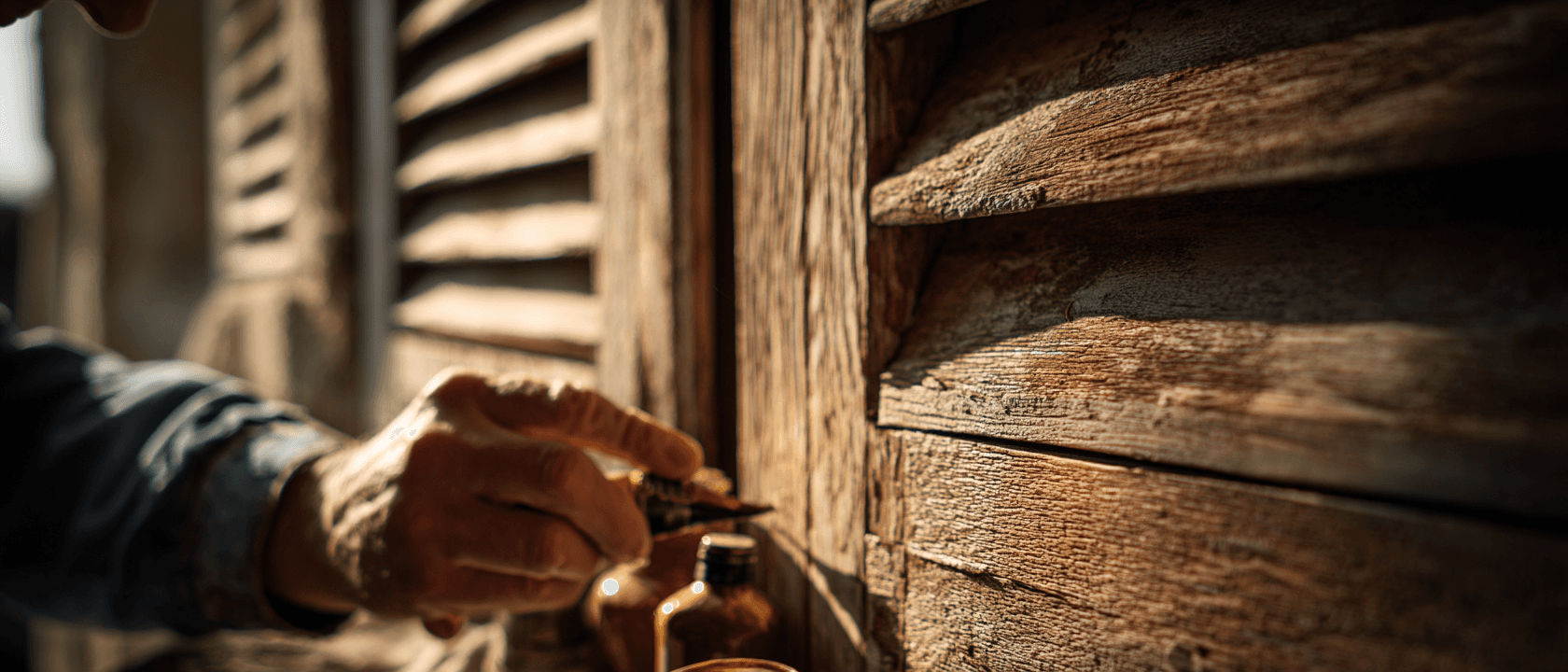
Ready-to-use specification documents for heritage architects
Architects & specifiers
Seeds supports heritage architects: specification clauses (CCTP) ready to insert into your tender documents, and a clear set of arguments to convince your clients.
Written documents
Choose the substrate and the context: the specification text adapts — description, application, environmental requirements. Copy it as is into your painting works package.
Royalty-free text, to be adapted by the project architect.
Specifications — Painting package · specification extract
Seeds
French-made linseed oil paint, SEEDS type or equivalent, intended for old woodwork (joinery, shutters, doors), for exterior use. Binder: linseed oil from flax grown in France; mineral pigments; free of petroleum solvents and harmful VOCs. As the building is a protected historic monument, the selected paint shall respect the original materials and remain reversible; linseed oil paint, historically used on this type of element, meets this requirement.
Preservation of sound, well-adhering existing coats: washing down, light sanding with fine-grit paper, thorough dusting. No general stripping; only loose flakes shall be removed and gaps filled. Areas of bare wood shall be nourished with a first coat of diluted linseed oil.
Brush application in thin, well-stretched coats, following the grain or the length of the element: three finishing coats, at 24–48 h intervals depending on conditions. Indicative coverage: 10 m²/L per coat. Application temperature between 8 and 30 °C, on a dry substrate. Do not apply in rain or when dew is imminent.
The product shall be bio-based (plant-based binder), free of petroleum solvents, and manufactured in France. The contractor shall provide the technical data sheet, the safety data sheet and the manufacturer’s environmental declaration.
The contractor shall produce a sample area subject to the project architect’s approval before general application. Colours shall be selected from the manufacturer’s colour chart and approved on site.
Technical and safety data sheets available at seeds.fr/technique. Indicative emission factor 1.8 kg CO₂e/L, to be confirmed by EN 15804 LCA.
Convincing the client
Three arguments that win the decision in a meeting — each answers a classic client objection — followed by three supporting points.
“What about old buildings?”
Permeable to water vapour, it does not trap moisture: essential on old joinery, stone and living substrates.
« It is the only type of paint I specify on a listed building. »
“How long will it last?”
Linseed oil penetrates the substrate instead of forming a brittle film: it does not blister, wears by chalking and can be renovated without stripping.
« You repaint less often, and never strip: the cost over 20 years is lower. »
“Is it a chemical product?”
The binder is linseed oil grown and pressed in France. No petroleum resin, no petroleum solvent, no VOCs harmful to occupants.
« It is the paint that was already used on your shutters two centuries ago — better formulated. »
Around 10 m² per litre per coat, and a service life that divides the number of repaints: more economical per maintained m² over 20 years.
A product figure that the client can reuse in their own reporting.
See the detailed carbon footprint →The only industrial linseed oil paint manufacturer in France: local supply chain, traceability, technical support that visits your site.
Our experts review your written documents and provide samples, colour charts and technical data sheets. For your tender responses, also generate the one-page CSR summary.
Natural shades inspired by historic pigments, ready to enhance your project.
Discover our collections